

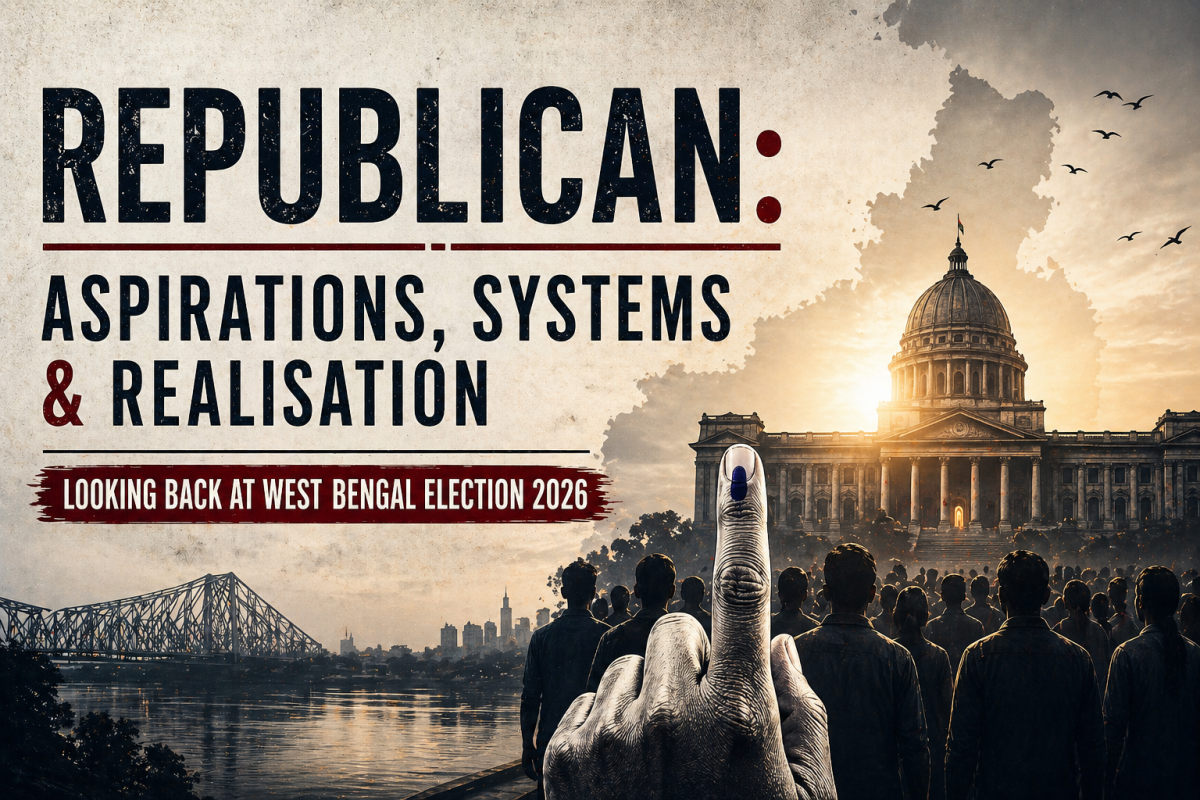
A republican framework rests on three principal constituents: the administrator, the administration, and the administered. The operative word is republican — of the people, by the people, for the people. The administrator exists to serve; the people are what matter. Sustaining both the system and the people's faith in it is the responsibility of the Election Commission.
A republican framework rests on three principal constituents: the administrator, the administration, and the administered. The operative word is republican — of the people, by the people, for the people. The administrator exists to serve; the people are what matter. Sustaining both the system and the people's faith in it is the responsibility of the Election Commission.
The people, however, are not a collection of individuals. They are a society. The individual is a constituent of that society, not above it. But this is precisely where everything goes wrong. Personal desire, ambition, fear, and hardship pull the individual away from the social whole. And those who seek to hold power accelerate this separation deliberately, hollowing out society until the individual stands isolated, dependent, afraid. Trust is replaced by fear. The governance of society becomes the governance of a person.
This is what happened in West Bengal. Elections that belonged to the people became, in practice, the personal project of one individual: her survival, her family's dominance, and the operations of a private political consultancy called I-PAC. The administrator was made to matter more than the administered.
But here is what had to be understood: that inversion was not permanent. It could be undone. And these elections in West Bengal were precisely the moment to undo it, to establish through the act of voting that the people are larger than any one person, that no administrator stands above those she is meant to serve. The Election Commission's role in protecting that act was therefore not incidental. It was foundational.
And when formal civil society, the intellectuals and the institutions, sold itself for personal gain, it was not the end. It was the moment when quieter forces emerged. Organisations like USTHI, the United Primary Teachers Association, worked without fanfare, building unity and fearlessness among ordinary people. They did not make headlines. But they were the ones keeping the system alive. And that, too, was the people's power at work.
But the real hero of this election was neither an organisation nor an institution. It was the ordinary voter. The person who stepped out of their home despite years of fear, despite intimidation, despite being told repeatedly that their vote did not matter, that the result was already decided. They stepped out anyway. They stood in line. They pressed a button. In that quiet, unheroic, utterly ordinary act, they did something extraordinary: they reclaimed the republic for themselves.
The Election Commission, by ensuring that not a single innocent life was lost during this election, something that would have been unthinkable in the history of West Bengal's elections, announced in effect the end of a legacy. The legacy of an administrative culture that had normalised violence as a feature of electoral politics met, today, something that looks very much like a conclusion.
Thank you to USTHI. Thank you to the Election Commission. Thank you to every voter who chose to show up.
The verdict now belongs to the people. If they chose change, change will come. If they chose to return the same administrator, that too must be accepted with grace. This is both the beauty and the discipline of democracy.
But counting day is not the end. Whoever wins, the work does not stop. The vigilance that brought people out to vote must remain. Accountability cannot be a season; it has to be a habit. The republic is not restored in a single election. It is rebuilt, slowly, by people who refuse to stop caring. That is the longer task. And it begins the morning after.
Jai Hind. Vande Mataram.
Rate this Article
Your response to this piece
Discussion (3)
Join the conversation
Share your perspective