

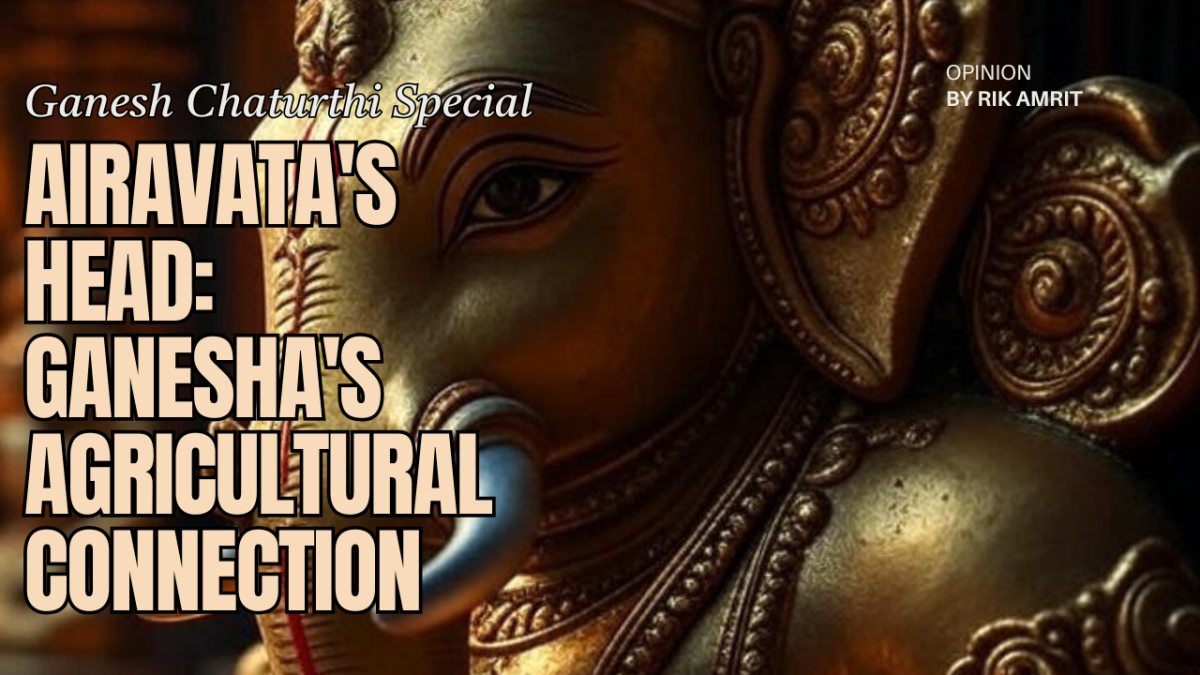
Airavata served as Indra's mount, helping the sky-god release rain by shattering clouds with thunderbolts. In agricultural societies dependent on monsoons, elephants naturally symbolized fertility and abundance. Only well-watered, vegetation-rich lands could sustain these massive creatures. By receiving Airavata's head, Ganesha inherited this rain-bringing power.
Parvati created a son from turmeric paste scraped from her body and ordered him to guard her cave. When Shiva tried to enter, the boy refused passage. Enraged, Shiva beheaded him with his trident. To pacify the grieving Parvati, Shiva promised to replace the head. He sent his followers north to bring back the head of the first creature they encountered.
When Shiva's followers were sent north to find a replacement head for the beheaded Vinayaka, they encountered Airavata, Indra's white elephant, on the Himalayan foothills. This wasn't random—it encoded crucial agricultural knowledge.
The Rain Connection
Airavata served as Indra's mount, helping the sky-god release rain by shattering clouds with thunderbolts. In agricultural societies dependent on monsoons, elephants naturally symbolized fertility and abundance. Only well-watered, vegetation-rich lands could sustain these massive creatures. By receiving Airavata's head, Ganesha inherited this rain-bringing power.
The Brihaddharma Purana explicitly states this connection, and Bengali traditions reflect it by depicting Ganesha with a white elephant head, directly referencing Airavata's coloring.
Agricultural Timing
Ganesha festivals occur during crucial agricultural periods. Ganesh Chaturthi falls in Bhadrapada (August-September) as monsoons wane and the earth shows green abundance. This timing connects his worship directly to agricultural cycles—celebrating successful rains while preparing for harvest.
The dual annual worship of Ganesha and his mother Gauri corresponds to India's two agricultural seasons: rabi (spring) and kharif (autumn).
Vighnaharta in Farming
As obstacle-remover (vighnaharta), Ganesha addresses agriculture's primary challenge: unpredictable disruptions. Drought, floods, pests, and weather variations threaten crops constantly. Farmers needed divine intervention to overcome these obstacles.
His symbolic control over the rat—a major agricultural pest—represents transforming destructive forces into allies. His associations with fertility symbols like grass (durva) and serpents reinforce his role as agricultural guardian.
Vegetation Worship
During festivals, nine medicinal herbs including turmeric, rice, and banana are tied together and placed beside Ganesha as goddesses. This practice explicitly connects divine favor with agricultural abundance, making Ganesha the mediator between human farming efforts and natural fertility.
The Airavata connection explains Ganesha's enduring agricultural relevance: he embodies the rain-bringing power essential for farming success, wrapped in accessible mythological form.


Rate this Article
Your response to this piece
Discussion (0)
No voices yet
Be the first to contribute to this discussion.
Join the conversation
Share your perspective