

Some stories never really leave us.
They return in new forms, wearing new clothes, speaking new languages—but asking the same old, essential questions.
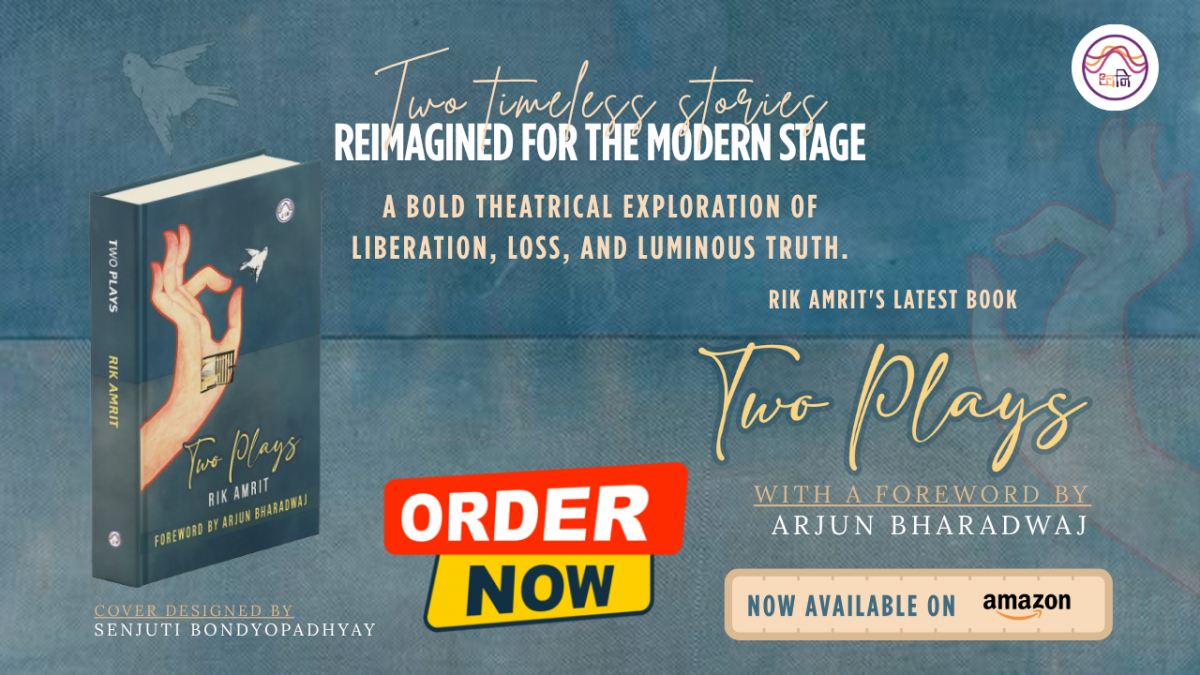
Two Plays brings together two such stories.
One draws from a Buddhist Jātaka tale. The other from the vast Mahābhārata. On paper, they come from two distinct traditions. But on stage—and in life—they meet in a shared space: a space where spiritual teachings collide with human ambition, and where sacred stories are sometimes twisted to serve dangerous ends.
🎭 From Stage to Page
For years, these plays lived in the theatre. I wrote them not alone, but in rehearsal rooms—with actors, with breath, with sweat. A Nirvāṇa first appeared as Swarna-Saṅghāra in 2019, performed at the Yaśodharā Festival. Aśvatthāmā—The Night Warrior began life in 2016 as Ashwatthama the War Machine, performed with Bengal Repertory.
They were shaped not just by my imagination, but by the presence of performers, by the silence between lines, by how a body reacts when a story hits too close to home.
Publishing them now—translating them from Hindi and Bengali into English—is both thrilling and terrifying. A performance disappears after the final bow. A book stays.
🐚 Why These Stories?
A Nirvāṇa tells the tale of a golden peacock who seeks freedom from suffering, while humans chase it for selfish gain. It quietly questions the cost of development—especially when it comes at the price of sacred lives and spaces. When we hear of peacock habitats razed in Telangana, the old tale hits differently.
Aśvatthāmā—The Night Warrior reimagines one of the most tragic characters from the Mahābhārata—a warrior cursed to live forever, consumed by revenge. The play probes the violence that grows out of distorted faith. After incidents like the Pahalgam terror attack, the story feels disturbingly close.
These are not retellings. They are re-seeings—attempts to ask:
📍 What happens when we lose our moral compass?
📍 Can we still find wisdom in the wreckage of belief?
📍 Do ancient tales still hold light for modern darkness?
🪶 The Process of Translation
These plays weren’t born in English. Translating them meant more than switching languages—it meant preserving emotion, rhythm, silence. I owe immense thanks to my mentor, Shri Arjun Bharadwaj, whose faith in the relevance of these tales pushed me to share them beyond the stage.
Language, like theatre, is alive. And like the characters in these plays, my words had to learn to breathe again—in a new tongue, for new readers.
📘 Why Read Two Plays?
These plays aren’t here to give you answers.
They’re here to disturb you a little. To make you think.
They ask:
-
What do we sacrifice in the name of progress?
-
How do cycles of violence begin—and how do we break them?
-
Can ancient wisdom still guide us through modern chaos?
In a time when stories are often used to divide, Two Plays tries to use them to connect. To invite dialogue between the past and the present, between art and action, between grief and hope.
📍 Read, Reflect, Respond
Two Plays is now available in both paperback and Kindle formats.
📖 Get your copy on Amazon
(And if you do read it, I’d love to hear your thoughts.)
Theatre may begin on the stage, but it doesn’t end there.
It moves into conversation, into reflection, into change.
Thank you for making space for these stories. I hope they move you—quietly, deeply, and unexpectedly.
Rate this Article
Your response to this piece
Discussion (0)
No voices yet
Be the first to contribute to this discussion.
Join the conversation
Share your perspective